


PX625 Battery: Problems, Alternatives & the V80H Battery Solution with USB-C Charger
Community tip: Troeszter.net
The freely available DIY building instructions from Troeszter.net — with circuit diagram and parts list. The idea to use a V80H as a PX625 replacement comes from here.
Table of contents
- The PX625 problem — Why your old camera misexposes
- All alternatives compared
- The V80H solution — Rechargeable battery with USB-C
- Criticism and concerns — What skeptics say
- For DIYers — The original building instructions
- What our customers say
1. The PX625 problem — Why your old camera misexposes
The Rollei 35, the Leica CL, the Olympus OM-1, the Canon F-1, the Minolta SRT series — all legends of analog photography. And all have the same problem: They were designed for a battery that has been banned since the 1990s.
The PX625 was a mercury button cell with exactly 1.35 volts. Not 1.3. Not 1.4. Exactly 1.35 V, and constant throughout its entire lifespan. This stability was why camera manufacturers calibrated the entire light meter circuit to it.

Since the ban, there have been three major replacement strategies. Each has weaknesses.
Warning: 1.5 volts are not “approximately the same”
The difference between 1.35 V and 1.5 V sounds small — but it’s 0.15 V. That’s enough to throw your camera’s light meter off by half to a full stop. For slide film, that means misexposure. For negative film, you’re in the lucky range of exposure latitude, but it’s not a reliable system in the long run.

Discharge curves compared: Alkaline (orange) drops steeply from 1.5V. Zinc-air (blue) stays close to the 1.35V line. Mercury (green) is the original — constant at 1.35V. NiMH LSD (magenta) starts at ~1.4V, quickly drops to about 1.25V, then holds a long, stable plateau at 1.25-1.30V.
Not every camera reacts with the same sensitivity. What matters is whether the device has a so-called bridge circuit (voltage compensation):
| Camera | Bridge circuit? | 1.5V tolerant? |
|---|---|---|
| Rollei 35 / 35S / 35T | No | No — shows incorrect values |
| Leica CL / M5 | No | No — sensor cell directly coupled |
| Olympus OM-1 / OM-1n | No | No — up to 2/3 stops off |
| Minolta SRT (101, 303 etc.) | No | No |
| Nikon F (Photomic) | No | No |
| Canon F-1 | No | No — CdS circuit without compensation |
| Pentax Spotmatic (all models) | Yes | Yes — Wheatstone bridge circuit |
| Nikkormat FTN | No | No — uncompensated series connection |
Cameras with bridge circuits (marked green) handle any battery voltage. Most classics — including the Rollei 35 and Olympus OM-1 — need a voltage close to 1.35 V, or the light meter lies.
2. All alternatives compared
There’s no perfect PX625 replacement. Every solution is a compromise. Here are the four most common strategies, honestly rated:
| Solution | Voltage | Cost/use | Lifespan | Rating |
|---|---|---|---|---|
| Alkaline LR44 + adapter | 1.5 V → drops to ~1.0 V | about 0.30 EUR | Months to years | 2/5 — Cheap, but wrong voltage |
| Silver oxide SR44 + diode | ~1.35 V (with diode) | about 1.50 EUR | 1-2 years | 3/5 — Works, mechanical risk with SR44 |
| Zinc-air 675 / WeinCell | ~1.35-1.4 V (flat) | about 3-5 EUR | 4-8 weeks (activated) | 3/5 — Best voltage, but dries out |
| Varta V80H (LSD-NiMH, rechargeable) | ~1.25-1.30 V (stable) | 9.90 EUR (each) / < 0.02 EUR per cycle | 500-1,000 charge cycles | 4/5 — Sustainable, just under 1.35 V |
Practical tip: Which solution is for whom?
Occasional photographer: Our O-ring adapter with zinc-air battery is enough. Affordable, the voltage is right, and one battery lasts a whole photo walk.
Regular user: The V80H with charger saves money and waste in the long run. Charge once, shoot for weeks, recharge.
Cameras with bridge circuits (Pentax Spotmatic): Here even a simple LR44 with an adapter works. The battery issue with these cameras is only mechanical, not electrical.
The problem with zinc-air (WeinCell & hearing aid batteries)
Zinc-air cells provide the voltage closest to the PX625. That’s their big advantage. But two drawbacks make them impractical for everyday use:
Self-discharge: As soon as you peel off the protective foil, the battery starts to discharge — even if the camera is off. After 4-8 weeks it’s done, whether you’ve taken photos or not. If you put the camera in a drawer for two months, the battery will be dead.
Costs: A WeinCell costs 4-5 EUR. With regular use, that adds up to 30-60 EUR per year. Hearing aid batteries (type 675) are cheaper but often run out after just 3-4 weeks. A trick from the forums: tape over three of the four air holes with Tesa — then the 675 lasts 4-6 months at a stable 1.35V. It works, but it’s a bit of a hack that you have to redo every time you change the battery.
3. The V80H solution — Rechargeable battery with USB-C charger
The Varta V80H is a NiMH button cell actually intended for circuit board backups in servers. However, it has exactly the same dimensions as a PX625 and delivers a resting voltage of 1.25 V. Freshly charged, it is at 1.30-1.32 V. Both are close enough to the original 1.35 V to provide correct exposure values on most cameras.
Why 1.30 V instead of the nominal 1.2 V?
The “1.2 V” on the datasheet is the nominal voltage — the statistical average over the entire discharge cycle. In practice, a freshly charged NiMH cell delivers 1.40-1.45 V, drops in the first hours to about 1.30 V, and then holds a long, flat plateau at 1.25-1.30 V. Only at the very end (last 10% capacity) does the voltage drop below 1.2 V. So in everyday use, the V80H is much closer to the 1.35 V of the PX625 than the nominal voltage suggests.
Why the V80H is not a normal NiMH battery
In forums, you often read: "NiMH batteries discharge quickly, after three weeks the battery is unreliable." That’s true — for standard NiMH batteries from the supermarket. But the V80H is not a standard battery. It belongs to the Varta "Robust" family and is a so-called LSD NiMH battery (Low Self Discharge). This category was specially developed for applications where the cell must hold charge for months — real-time clocks in servers, medical measuring devices, backup systems.
The difference to standard NiMH is significant:
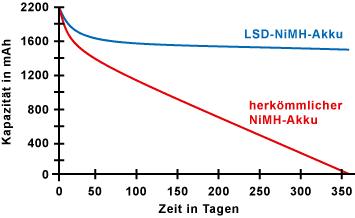
Self-discharge comparison: Standard NiMH batteries (left) lose capacity quickly, LSD NiMH (right) last significantly longer. Source: Elektronik-Kompendium.de
The V80H, as an LSD NiMH battery, has an extremely low self-discharge rate, comparable to modern LSD batteries (like the Eneloop series). The self-discharge stabilizes after the first month to just a few percent — after one year of storage at room temperature, most of the capacity is still available.
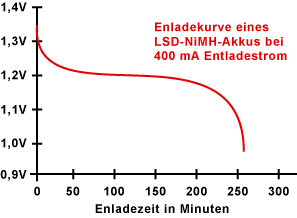
Discharge curve of an LSD NiMH battery: The voltage initially drops from 1.35V to about 1.2V and then remains stable for hours. With minimal current consumption (like in a light meter), the plateau lasts significantly longer. Source: Elektronik-Kompendium.de
This explains Troeszter's measurements
The discharge curve shows: during discharge, the voltage of a NiMH battery drops quickly from about 1.35V to ~1.2V. But then this value stays stable for hours. Because a camera’s light meter only draws microamps, this plateau lasts not hours but weeks. That’s exactly what Troeszter measures: 1.30-1.32V in week 1, then slowly dropping to 1.25-1.27V — where the value stabilizes and holds for "several weeks".

Feature: USB-C charger — Just charge overnight

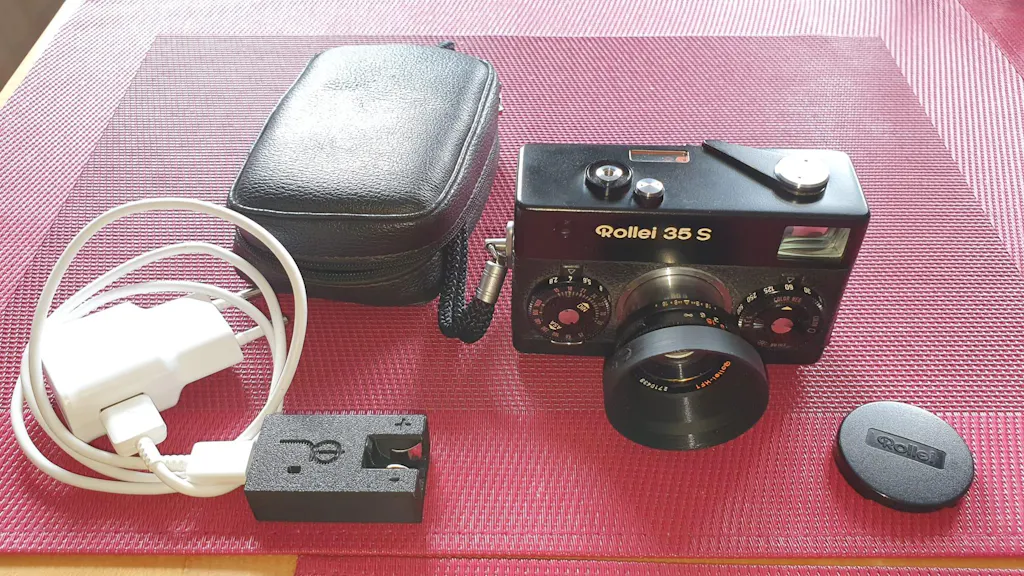
The charger is compact enough for any camera bag. Plug in the USB-C cable, insert the V80H, charge overnight — done. The blue LED shows that charging is in progress. To be honest: the LED currently doesn’t indicate when the battery is full — that’s planned for the V3 version. That’s why we recommend simply leaving the charger connected overnight. A full charge takes about 9 hours with gentle slow charging (C/7). The slow charging is intentional: it significantly extends the battery’s lifespan.
Feature: Varta V80H — Same form factor as PX625

No adapter, no O-ring, no tinkering. The V80H fits directly into any PX625 battery compartment. Insert, close the cover, done. Works in the Rollei 35 just like in the Leica CL or Olympus OM-1.
Especially relevant: Cameras with battery compartments inside the film chamber
In some classics — including the Rollei 35 and the Leica CL — the battery compartment is inside the film chamber. That means: for every battery change, the loaded film must be removed or exposed. With disposable batteries (zinc-air, alkaline), the swap becomes a logistical problem.
The V80H set was designed exactly for this situation. Two batteries alternating, one always freshly charged — and with every film change, the battery is swapped too. No extra opening of the film chamber, no risk to the loaded film. That was one of the main reasons we developed the charger.
Hack: Compact travel companion
The charger weighs under 20 grams and fits in your pocket. Combined with a USB-C power bank, you have battery power on the go while traveling. No hunting for special batteries in unfamiliar cities.
Important: The charger only draws 12 mA. Most power banks shut off after 30 seconds at such a low current (auto-shutoff). Your power bank needs a trickle charge or wearable mode — often activated by double-clicking the power button. Without this mode, the battery won’t charge.
Feature: Pro Pack — Never run out of power again

The Pro Pack contains two V80H batteries. One in the camera, one in the charger. So you’re covered even on multi-day photo trips — one battery typically lasts 2-4 weeks of normal shooting.
Technical data
| Battery type | Varta V80H (LSD-NiMH, "Robust" series) |
| Nominal voltage | 1.2 V (according to manufacturer) |
| Operating voltage (plateau) | 1.25 – 1.30 V |
| Freshly charged | 1.30 – 1.32 V |
| Capacity | 80 mAh |
| Charging time | approx. 9 hours (slow charge C/7, overnight) |
| Charge cycles | 500 – 1,000 (Varta Robust series, LSD-NiMH) |
| Charger connection | USB-C (PD compatible) |
| Charger material | Technical plastic |
Video: The story behind the PX625 USB-C charger
4. Criticism and concerns — What skeptics say (and our response)
We wouldn’t be honest dealers if we ignored legitimate criticism. In the relevant forums — from Bilderforum.de through APHOG to Photrio — there are valid concerns about NiMH batteries as PX625 replacements. Here are the most common:
Objection 1: “NiMH batteries only have 1.2 V — that’s too little"
Klaus-R, an experienced moderator at Bilderforum.de, puts this point clearly on the table:
Critical voice from Klaus-R (Bilderforum.de)
“In the end, you get gradually increasing overexposure instead of gradually decreasing underexposure with 1.5V solutions. [...] 1.2V is just as far from the required 1.35V as the 1.5V of an alkaline battery."
The math checks out: 0.15 V difference in both directions if you start from the nominal voltage. In practice, it looks different. Troeszter measures freshly charged 1.30-1.32 V in the Rollei 35. The difference to 1.35 V is then 0.03-0.05 V — less than 1/3 stop. With negative film’s huge overexposure latitude, that’s not a visible difference.
Crucial: The direction of deviation. A V80H with 1.30 V leads to minimal overexposure (which negative film handles easily). An alkaline with 1.5 V causes underexposure — barely noticeable in low light (EV 6), but up to 2 stops in bright sunlight (EV 15), because the CdS curve is not linear. Underexposure is the one direction that really causes problems with negative film.
Objection 2: "Self-discharge — after a few weeks the battery is empty"
Klaus-R also addresses this:
Critical voice from Klaus-R (Bilderforum.de)
"After three weeks, NiMH batteries are so unreliable in terms of residual voltage that only freshly charged and still healthy batteries can ensure reliable exposure metering."
That’s true for standard NiMH. Conventional NiMH batteries from the supermarket lose 10 to 20 percent of their charge after just a few days. Klaus-R is right about that.
The V80H is not a standard NiMH — it is an LSD-NiMH battery (Low Self Discharge), as we explain in the chapter above. LSD-NiMH loses about 15% in the first month, then only a few percent per month. After one year: still 80% capacity. Troeszter's measurement data confirm exactly this:
Long-term measurement by Troeszter.net (Rollei 35T / 35S)
"My experience: Fully charged and inserted into a Rollei 35T or 35S, the V80H battery maintains a voltage of about 1.30 to 1.32 volts for about a week. After a second week, the voltage drops to 1.27 to 1.28 volts. Four weeks after charging, it still has 1.25 to 1.27 volts and maintains this level for several weeks. The solution works very well for me because the light meter gives identical readings with both a mercury button cell and the V80H battery. I verified this with a test setup (standard light table in a darkened studio)."
— Troeszter.net, PX625 battery adapter assembly instructions
In practice, this means: charge briefly before every photo tour, then you have a reliable system. However, if you keep your camera in the closet for months and want to head out spontaneously, alkaline + ISO correction is still a good choice — we say that openly. The V80H shows its strength with regular use.
Objection 3: "80 mAh capacity is less than SR43/SR44"
True. A user from France, MATHIEU, writes in his customer review:
Customer feedback from MATHIEU
"Varta V80H are only 80mAh compared to the 130mAh or more with SR43W and an adapter. [...] I fear I will have to swap them each time I change the roll to avoid losing metering."
True, 80 mAh sounds low at first. For comparison: an SR43W has 130 mAh, zinc-air (type 675) even 630 mAh. But the numbers are irrelevant without context. A CdS light meter draws 50-100 microamps. With 80 mAh capacity, that theoretically means 800-1600 hours of active measuring time. In practice, self-discharge limits, not capacity. And that’s exactly the advantage: you recharge the V80H. After 500 cycles, it has delivered a total of 40,000 mAh — more than any disposable battery will ever deliver.
Objection 4: “The price”
We get it. That’s why we offer two entry points: If you just need the right voltage, get our O-ring adapter with zinc-air batteries from 14.90 EUR. If you want to stop buying batteries long-term, choose the V80H set. Both solutions exist side by side — we sell both in the shop because different photographers have different right solutions.
Practical tips: What you should know
Battery check shows “empty” — even though the battery is full
Many cameras (Olympus OM-1, Minolta SRT) have a battery check switch calibrated exactly to 1.35 V. The V80H with its 1.25-1.30 V plateau will almost always show red on the battery check — even though the light meter works perfectly. This is not a defect. Trust the light meter, not the battery check.
Cold: NiMH and winter don’t get along
Mercury cells were voltage-stable down to deep subzero temperatures. NiMH batteries are not. Below 5°C, the internal resistance of the V80H rises, the voltage plateau dips, and the light meter can be off. If you shoot in winter: keep the camera and battery warm in your jacket pocket. For constant frost, a zinc-air cell is the better choice.
Right after charging: wait 1-2 hours
A freshly charged NiMH battery has a charge-end voltage of over 1.40 V. If you put it immediately into the camera, the light meter measures with too high a voltage — and gives incorrect readings. Let the battery rest for 1-2 hours after charging. During this time, the voltage drops to a stable 1.25-1.30 V plateau.
Cameras without a real off switch (Rollei 35 and others)
The Rollei 35 draws power as soon as light hits the CdS cell — even when switched off. Leaving it on your desk without the lens cap means constant power drain. With only 80 mAh capacity, the battery can be empty in 3-4 days. Always put the lens cap on when the camera is not in active use.
5. For DIYers — The Original Construction Manual
The idea to use a Varta V80H as a PX625 replacement comes from Troeszter.net. His DIY manual (freely available as a PDF) shows how to build your own V80H charger with a wine cork adapter and lab power supply. If you can solder and enjoy it, go for it — we link the manual intentionally.
Our charger shares the basic idea (V80H + constant current charging) but takes a different approach: custom PCB, USB-C instead of lab power supply, housing made of technical plastic with precise spring contacts instead of copper foil. Troeszter’s work was the starting point — the result is an independent product.
Overview of the Troeszter solution
The construction manual describes a DIY charging adapter made from a wine bottle plastic stopper with copper foil contacts. Troeszter uses an adjustable lab power supply as a direct voltage source (set to 1.33-1.37 V). The LM317 is wired as a current limiter: a 100-ohm resistor between OUT and ADJ limits the charging current to about 12 mA. The charge cutoff voltage is set by the power supply and monitored manually — in this setup, the LM317 regulates current only, not voltage.
| Component | Details |
| Charging current | 12 mA (LM317 regulated) |
| Charge cutoff voltage (at the battery) | max. 1.37 V (set by the power supply) |
| Charging time | approx. 9.5 hours |
| Power source | Adjustable lab power supply (set to 1.33-1.37 V) |
| Total components | 3 (LM317LP + C1 0.1µF + R1 100 Ohm) |
| Electronics cost | approx. 1.90 EUR |
Warning: What the DIY solution requires
You need an adjustable lab power supply (e.g. Voltcraft), soldering experience, and a multimeter. The LM317 limits the current to 12 mA but does not regulate the final voltage — you set it on the power supply to max. 1.37 V and monitor it manually. Without reverse polarity protection, incorrect insertion can damage the battery. If you have these skills — great. For everyone else, we offer our ready-made set.
You can find the complete construction manual with circuit diagram and photos as a PDF here: Troeszter.net — PX625 Battery Adapter Construction Manual
Hack: There is an alternative suggestion in the Bilderforum
Moderator Klaus-R in the Bilderforum suggests placing the V80H with a wine cork and aluminum foil contacts into a standard AA charger. Creative, free, but mechanically tricky — short-circuiting when inserting is a real risk. If you want to try it: at your own risk.
6. What our customers say
17 reviews, 4.88 out of 5 stars. Here are some unedited comments:
Independent test by Sorin Lazarescu (Verified Purchase)
Sorin tested the V80H battery against his Sekonic handheld light meter:
- Voigtländer VF 135: Battery inserted (measured: 1.23 V), light meter compared with Sekonic — result: identical values.
- Conclusion: "Finally a viable, elegant and reliable solution for the (in)famous PX625 batteries."
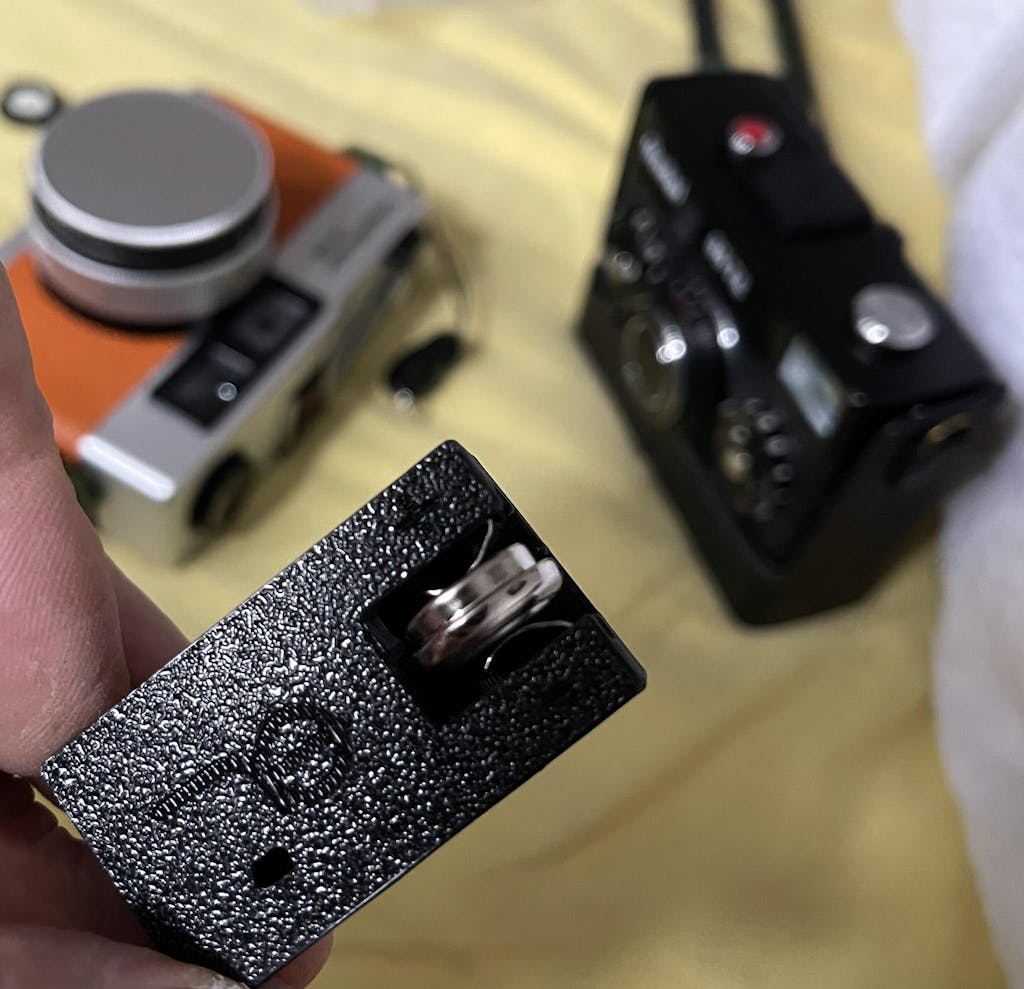
Photo: Sorin Lazarescu — comparison test V80H vs. Sekonic on the Voigtländer VF 135
Independent test by Harald Wittig (Verified Purchase)
Harald uses a Nikon F, Canon F-1, and Pentax Spotmatic F:
- Result: "Everything works perfectly, the light meters show reliable values."
- Note: "By the way, it has no bridge circuit!" — about his Pentax Spotmatic F.
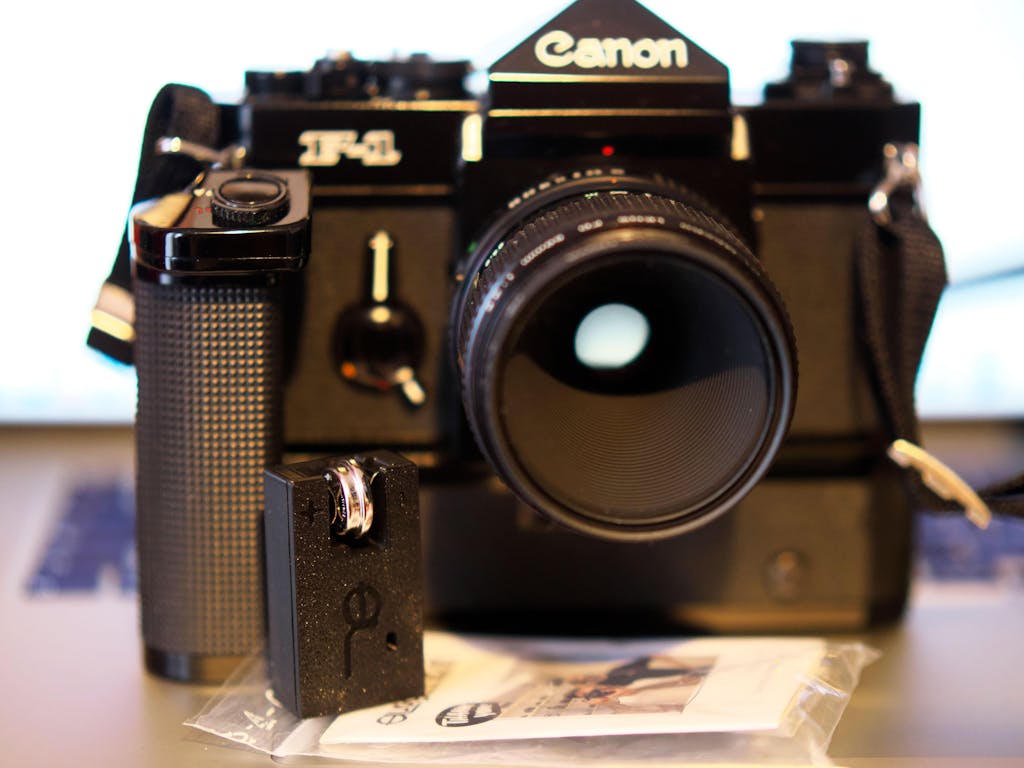
Photo: Harald Wittig — V80H in use with Nikon F, Canon F-1, and Pentax Spotmatic F
Customer photo from real use — V80H battery set in action
Customer review by Bill Smith (Verified Purchase)
"Having a 1.3V rechargeable 625 battery is a brilliant idea. I have a bunch of cameras in my collection that use the 625 battery; some have been converted to 1.5V, some haven't. This is the perfect solution for the cameras without voltage conversion."
Customer review by Jürgen Kwiatkowski (Verified Purchase)
"I have many old devices that unfortunately require the old mercury batteries. So far, I was able to use hearing aid batteries. But they only last for a limited time and then have to be disposed of. The new Varta rechargeable batteries work perfectly for me. Of course, they eventually run out too, but you can recharge them with the new charger."
What Reddit says about it
In the r/AnalogCommunity subreddit, the V80H charger was presented by the Ausgeknipst founder himself. Community feedback: mostly positive, with some questions about capacity and price — both of which we addressed above. Several users confirm that the V80H delivers correct exposure values in their cameras (Rollei 35S, OM-1). The V80H is also discussed as an alternative in the Photrio forum — the main question there was: "But how do you recharge them?" That’s exactly why we built the USB-C charger.
The discussion continues — in these forums
We deliberately wrote the article based on real community questions. You can find the original discussions here:
- Bilderforum.de — Detailed technical analysis by Klaus-R
- APHOG Forum — Discussion among analog photographers (DE)
- Reddit r/AnalogCommunity — International community feedback
- Photrio — PX625 alternatives in the English-speaking forum
Our PX625 solutions overview

Charger + battery — V80H set with USB-C

Varta V80H replacement battery (NiMH)

PX625 O-ring adapter with batteries

Battery compartment tool (1.7mm steel)
All PX625 solutions at a glance
Adapters, batteries, and tools — everything you need to power your analog camera.
More tutorials and guides
Our blog articles help you get the most out of your analog camera.
Who is behind Ausgeknipst?
We are Anto and Vladi from Würzburg. Engineers, analog photographers, and convinced that technology should solve problems — not create new ones.